Monday, April 23, 2012
"These 'triple doubles' are a 'slam dunk'!"
Visit the VSO Store to purchase a copy of Triple Doubles today.
The CD Triple Doubles presents three recent double concertos- works composed for violinist Jaime Laredo and cellist Sharon Robinson. Performed by the Vermont Symphony Orchestra (Laredo is the orchestra's Music Director), these performances have a remarkably personal quality, undoubtedly a result of the performers' close relationship with the composers and the unique bond of a husband and wife interacting with "their" orchestra. When Richard Danielpour began composing A Child’s Reliquary; he had just learned of the death of the young son of conductor Carl St. Clair. "I began to write a series of variations on, or around, the Brahms Wiegenlied." The work was originally written for trio, and was orchestrated in 2006. David Ludwig wrote his Concerto for Violin, Cello and Orchestra in three movements with two interludes between the movements. He writes: "I can think of no more natural a subject than Love for a double concerto written for Jaime Laredo and Sharon Robinson; two people devoted both to each other and to a lifetime of loving music." Daron Aric Hagen writes, "The double concerto Masquerade takes as its starting place the conventions of commedia dell'arte. The soloists take on the roles of musical lovers in the first movement Burlesque. Composed over a two year period, the concerto is dedicated to Jaime Laredo and Sharon Robinson.
Richard Danielpour: A Child's Reliquary (1999, 2006)
David Ludwig: Concerto for Violin, Cello and Orchestra (2008)
Daron Aric Hagen: Masquerade —Concerto for Violin, Cello and Orchestra (2007)
Jaime Laredo, violin
Sharon Robinson, violoncello
Troy Peters, conductor (Hagen)
Sarah Hicks, conductor (Danielpour, Ludwig) Keep reading!
Wednesday, April 18, 2012
Uncorking Spring this weekend!

Starting to think about your yard? This Saturday is the time to shop for all your gardening needs and support the VSO's educational programs at the same time! Uncorking Spring is a casual evening of music, wine tastings, hors d'oeuvres, raffles, and doorprizes to support the VSO's SymphonyKids Educational Outreach programs. The evening begins at 5:30 p.m. in the Conservatory at Gardener's Supply in Williston. Keep reading for additional information about the event.
Tickets are $25 and can be purchased online. Music will be provided by the VSO's Harp & Soul flute and harp duo. Gardener's Supply will donate 10% of the proceeds from the day's sales to the VSO.
Keep reading!
Labels: events, fundraising
Monday, April 16, 2012
15th Annual Radio Auction this Thursday at 6 p.m.!
The annual Radio Auction, presented by the Radio Vermont Group and hosted by Eric Michaels, is an exciting and interactive on-air event that raises $15,000-$20,000 each year for the VSO. All proceeds support the VSO's musical and educational programs across the state. Visit our website for a list of the fabulous items included in this year's auction. Bidders can listen anywhere in the world online. Vermonters should keep reading for a list of the stations that will broadcast the auction.
WDEV 550 AM: Serving Washington, Lamoille, Orange, Caledonia, and Orleans Counties
WDEV 96.1 FM (Lincoln Peak, Sugarbush): Serving the Mad River Valley and Champlain Valley, focusing on Washington, Orange, Grand Isle, and Addison counties
WDEV 96.5 FM (Barre): Specifically serving Barre
WDEV 101.9 FM (Island Pond): Serving the Northeast Kingdom
WCVT 101.7 FM (from the top of Mount Mansfield): All classical, all the time. Serving Barre, Montpelier, and the Champlain Valley
WCVT 102.5 FM (Montpelier): Specifically serving the Capital City
WLVB 93.9 FM: Serving Lamoille, Caledonia, and Orleans counties
Keep reading!
Labels: events, fundraising
Friday, April 13, 2012
Program notes: April 28

The Vermont Symphony completes its 2011/2012 Masterworks series on Saturday, April 28 at the Flynn Center in Burlington. The program begins with a beautiful piece commissioned by a consortium of 35 American orchestras, and inspired by Galileo’s book, Sidereus Nuncius, (Starry Messenger). Another star, pianist Alon Goldstein, is back with us by popular demand. He solos in an evocative work based on the popular music of Andalusia—including a zarzuela melody from a street violinist in Madrid. The sounds of festivals and dances is evoked by effects peculiar to Spanish folk instruments. The 2011/2012 Masterworks season concludes with Shostakovich’s first symphony, which he wrote at the tender age of 19 as a final exam thesis at the St. Petersburg Conservatory. Needless to say, he passed! And was catapulted into fame as his first masterpiece swept his reputation through the musical capitals of the world. Keep reading for the program notes.
Nights in the Gardens of Spain
Manuel de Falla (1876-1946)
“Without Paris I would have remained in Madrid submerged and forgotten,” said de Falla, who spent seven years in the French capital in the company of such composers as Debussy, Dukas, Albéniz, and Fauré. In 1909, he began a series of solo piano pieces titled Nocturnes. Albeniz and pianist Ricardo Vines persuaded him to score the music for piano and orchestra.
Returning to Spain in 1914, de Falla continued to revise what he now called Nights in the Gardens of Spain, first in Barcelona, and later at the home of Catalan painter Santiago Rusinol in the coastal fishing village of Sitges. Some say the music was inspired by Rusinol’s paintings of Spanish gardens. The first performance was given on April 9, 1916, by the Madrid Symphony Orchestra.
The influence of the impressionism of de Falla’s French friends—composers, poets, and artists—seems clear. Subtitled “Symphonic impressions for piano and orchestra,” the work has three movements, each bearing its own subtitle. The first, “In the Generalife,” refers to the jasmine-scented gardens surrounding the fourteenth century summer palace built by the Moors near the Alhambra in Granada. The opening seminal theme is virtually identical to a zarzuela melody by Amadeo Vives. Both musicians had lived in the same house in Madrid where an old blind violinist played the tune in the street below.
“The mere enumeration of the titles should be sufficient guide to the hearer,” said de Falla. “The music has no pretensions to being descriptive: it is merely expressive. But sometimes more than the sounds of festivals and dances has inspired these evocations in sound, for melancholy and mystery have their part also…. The composer has followed a definite design, regarding tonal, rhythmical and thematic material…. The end for which it was written is no other than to evoke places, sensations, and sentiments…. The themes employed are based on the rhythms, modes, cadences and ornamental figures which distinguish the popular music of Andalusia, though they are rarely used in their original forms. The orchestration frequently employs certain effects peculiar to the popular instruments used in those parts of Spain.”
Biographer Jaime Pahissa describes the three movements: “The first is pure atmosphere—all soft and languid orchestral sounds with pleasing chords and a short simple melodic theme like the primitive songs which are so deeply rooted in man’s daily life, in his prayers, street cries, lullabies, and childhood songs. The second (Distant Dance), which is distant and dreamlike at the outset, develops and grows more animated, passing without pause to the third (In the Gardens of the Sierra de Cordoba). This final movement is strongly rhythmical, but even so ends in a melancholy vein. All three movements contain two characteristic aspects of Andalusian music, alternating as they do between a vague nostalgic quality and brisk, exciting rhythms.”
Osvaldo Golijov (1960 - )
Sidereus
An interview with the composer...
How did you come to be chosen to compose a piece for the Henry Fogel Commissioning Consortium? When did you learn about it?
The League of American Orchestras put this project together back in 2008 to honor Henry Fogel. I learned, I think, through Linda Golding. I like and respect Henry Fogel, so I accepted the project.
What is your relationship to Henry Fogel?
I know the work he did in Chicago and the League, and was always impressed with his mind, his longterm thinking, his love for what orchestras represent in our society, and his wisdom in helping orchestras not only to survive but to thrive, through strategies that are specific to each of the orchestras’ communities and conditions. We did a public talk in Chicago a few years ago, and I found his questions about my music thought provoking.
What does the title, Sidereus, refer to?
A book by Galileo: Sidereus Nuncius or "Sidereal Messenger.” (It’s more commonly translated as "Starry Messenger" but to me the word “sidereal” is more beautiful.) He wrote it after observing the moon for the first time with the telescope. He also discovered Jupiter's moons, and started to get into trouble with the Vatican because of the incontrovertible evidence of the intelligent observation.
What ideas are behind the piece? Is the celestial reference in the title reflected structurally or harmonically?
The realizations of Galileo referred to the new discoveries in the surface of the moon. With these discoveries, the moon was no longer the province of poets exclusively. It had also become an object of inquiry: Could there be water there? Life? If there was life, then the Vatican was scared, because, as Cardinal Bellarmino wrote to Galileo: How were the people there created? How would their souls be saved? What do we do about Adam? Wasn't he supposed to be the first man? How do we explain the origin of possible life elsewhere? What about his rib? It’s the duality: the moon is still good for love and lovers and poets, but a scientific observation can lead us to entirely new realizations.
I’d say it’s the same with Van Gogh's self-portraits; they are both incredibly expressive and pure in pattern. You see that those same brushstrokes that delve into the depths of human experience and questions also reflect the patterns of galaxies, nebulae, and exploding supernovae.
In Sidereus, the melodies and the harmony are simple, so they can reveal more upon closer examination. For the “Moon” theme I used a melody with a beautiful, open nature, a magnified scale fragment that my good friend and longtime collaborator, accordionist Michael Ward Bergeman came up with some years ago when we both were trying to come up with ideas for a musical depiction of the sky in Patagonia. I then looked at that theme as if through the telescope and under the microscope, so that the textures, the patterns from which the melody emerges and into which it dissolves, point to a more molecular, atomic reality. Like Galileo with the telescope, or getting close to Van Gogh's brushstrokes.
While many of your earlier works draw from both your Jewish and Argentinean heritage, Azul marked an expansion for you compositionally. Does Sidereus follow this change of direction?
More or less. Actually, I’d say yes, but in a simpler way than Azul. Azul has the harmonic variety, contrast, and development of a full concerto. Sidereus is an overture.
Many of your works are written with specific musicians in mind—Dawn Upshaw, the Schola Cantorum de Caracas—or are custom scored to include non-traditional instruments. But in this case, you were commissioned to write a piece for chamber orchestra—actually 35 chamber orchestras. How did this affect the composition process? What does it mean to write one piece to suit 35 different orchestras?
It certainly felt more abstract, writing a piece to be interpreted by 35 or more ensembles with different expectations, different audiences, different personalities. The challenge was trying to create something that would serve them all.
Were you in touch with any of the orchestras or individual musicians through the process?
Not really during the process, just at the end with Mei-Ann Chen, the Music Director of the Memphis Symphony Orchestra. I have to say, she’s a great musician. I revised the opening section between Thursday's rehearsal and the dress, and she and the orchestra totally nailed it, great attitude and musicianship.
Typically following a world premiere there is a significant period for revisions but in this case the piece begins touring immediately after the premiere. How will this affect the revision process?
Well, I will tinker a little more with a dark theme that opens the piece and reappears in the middle. It’s sort of an ominous question mark that tears the fabric of a piece that is essentially spacious and breathes with a strange mixture of melancholy and optimism. I hope to make all revisions very soon, so that the tour can continue. (And so I can start work on my next piece!)
It is rare for any composer to have a piece interpreted by 35 orchestras in a lifetime, let alone within one year. Will you be traveling to any of the performances?
I wish I could. Apart from the premiere in Memphis, I will be relying mostly on performance recordings. But yes, this is a rather unusual honor to have a piece of my music performed by so many orchestras in such a short time.
Osvaldo Golijov interviewed by Sarah Baird Knight, 2010.
Symphony No. 1 in f minor, Op. 10
Dmitri Shostakovich (1906-1975)
Shostakovich completed his First Symphony in the spring of 1925 as the thesis for his final examination at the St. Petersburg Conservatory. Few symphonies by unknown students have so swiftly made their way to the musical capitals of the world, or have so quickly established the reputations of their composers. The young composer wrote this early masterpiece under the most depressing conditions. His family had been reduced to dire poverty by the Revolution, and Dmitri himself had to undergo two operations for an inflamed gland in his neck. On the plus side, during his convalescence in the Crimea, he fell in love for the first time!
During 1926, the year of the symphony’s premiere, Shostakovich did not write a single note. A decade later he wrote, “I sensed that music was not merely combinations of sounds, arranged in a particular order, but an art capable of expressing the most varied ideas and feelings.” It would seem that he knew this quite well enough in his First Symphony. Although it is not without academic overtones, the work broke away from the world of textbook traditionalism and entered its own artistic realm. Commentators have of course noticed certain derivative elements, especially other Russian composers such as Tchaikovsky, Stravinsky, and Prokofiev. What is striking is the way in which the young composer’s individual voice comes across with consistent clarity. His professors were so impressed with the finished score that they helped Shostakovich with the printing fees.
Allegretto; Allegro non troppo. A two-part theme is presented in the brief introduction by solo muted trumpet and solo bassoon. Above a pizzicato figure in the cellos, the clarinet delivers a sardonic version of the same angular figure. Following a pause, the motivic activity is assigned to the strings. The tempo then begins to hurry toward the main body of the movement. This section begins with a jaunty tune in the clarinet. A second almost Tchaikovskian theme is introduced by the flute over a pizzicato string accompaniment. The rather turbulent development of the themes is concluded by a forceful restatement of the introductory material in the trumpets. The movement ends quietly with reflective passages in clarinet and cellos.
Allegro. The mercurial second movement is the modern counterpart of the traditional Scherzo. After the main theme is announced by the violins, the composer adds a piano to the orchestral forces, which promptly takes up the melody. The mood becomes more subdued with the arrival of the Trio section, in which two flutes play their melody under a pedal high E in the second violins. The brilliance of the main section returns and builds to a climax in which the brass superimpose the Trio theme against the rest of the orchestra. A quiet coda follows.
Lento; Largo. A melancholy oboe solo, accompanied by string tremolo, opens the movement. Solo cello, then violins, prepare the way for a slower section that emphasizes the lower voices. The rhythmic pulse is ambiguous and the resulting cross-rhythms provide a subtle underpinning to this melancholy interlude. Rumination upon the thematic material continues until a drum roll leads directly into the finale.
Allegro molto; Lento; Allegro molto. An explosive single measure of Allegro molto is followed by 29 measures of introduction. The main body of the movement begins with an exuberant theme played by solo clarinet. This agitated and exciting movement progresses through many changes of mood and pace, and includes solos for violin, horn, timpani, and cello. The solo timpani, triple forte, pounds forth with terrifying menace the regimented martial rhythm (now inverted) of the slow movement’s fanfare. Thematic transformations abound as the upper strings attempt to revive their vibrant melody, but a brash martial motif dominates, and brings the symphony to a close.
Keep reading!
Labels: concerts, guest artists, Jaime Laredo, Masterworks, program notes
Wednesday, March 28, 2012
March 10, 2012 Masterworks recording on Instant Encore
Stream the recording below, or download from Instant Encore.
Keep reading!
Wednesday, March 7, 2012
Friday, March 2, 2012
Bring your non-perishable food items to the Flynn or the Paramount!
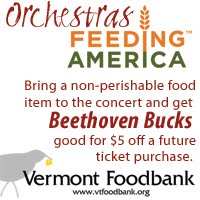
Again this year, the VSO will collect food items at its concert in Burlington as part of the national “Orchestras Feeding America” project. Audience members and the public may bring a non-perishable food item to the Flynn Theater lobby on March 10 or the Paramount Theater lobby on March 11. All food collected will be donated directly to the Vermont Foodbank and donors will receive “Beethoven Bucks,” good for discounts on future VSO ticket purchases. Suggested food items include boxed dry goods, canned goods and soups, cereal, pasta, rice, and peanut butter…please, no glass, perishables or clothing.
“Orchestras Feeding America” is a national food drive organized by the League of American Orchestras, representing America’s professional, volunteer, and youth orchestras. This is the fourth year of the program in which 250 orchestras in 50 states have so far collected over 350,000 pounds of food. The food drive demonstrates the collective power of America’s orchestras in undertaking a project designed to help feed the hungry in their local communities. Food collected by the VSO will be distributed to Vermont Foodbank partners around the state, to help ensure that all Vermonters have enough to eat.
Keep reading!
Labels: concerts, Masterworks, Sunday Matinee Series
Friday, February 24, 2012
Program notes: March 9-11
Second only to “Peter and the Wolf” in popularity, Prokofiev’s Classical Symphony is one part neo-classicism (harkening back to an 18th century idiom), and one part innovation, stirred by a belief that music should nourish with hope and beauty. The result is delicious! Our soloist for Richard Strauss’s first horn concerto is the amazing Jennifer Montone, principal horn with the Philadelphia Orchestra. Strauss’ abiding love for the heroic French horn, and his indebtedness to the style of Schumann and Mendelssohn, are evident in this remarkably mature early work. The concert concludes with Beethoven’s paean to heroism, his Third Symphony. Although the “Eroica” includes the most famous funeral march in the literature, death does not have the last word in this epic, immortal symphony. Keep reading for the complete concert schedule and program notes.
Friday, March 9, 7:30 p.m.
Bellows Falls Opera House, Bellows Falls
Saturday, March 10, 8 p.m.
Flynn Center, Burlington
Part of the Masterworks Series
Sunday, March 11, 4 p.m.
Paramount Theatre, Rutland
Part of the Sunday Matinee Series
Jaime Laredo, conductor
Jennifer Montone, horn
PROKOFIEV Classical Symphony
STRAUSS Horn Concerto No. 1
BEETHOVEN Symphony No. 3, "Eroica"
Classical Symphony, Op. 25
Sergei Prokofiev (1891-1953)
“It is the duty of the composer to serve his fellow men, to beautify human life and point the way to radiant future. Such is the immutable code of art as I see it.” –SP
Prokofiev’s first music teacher was his mother, and it is to her influence and the Beethoven sonatas he heard her play in his infancy that he attributed his penchant for neo-classicism, or the imitation of the classical style of the eighteenth century. Innovation was the other principal feature of his work in which he took pride, and it was a gibe at his “elementary harmony” from his teacher Taneieff which Prokofiev claimed was the foundation of his need for an individual idiom. This recipe of one part neo-classicism and one part innovation, stirred by a belief that music should endow mankind with a sense of hope and beauty, resulted in Prokofiev’s delicious Classical Symphony.
Growing up in a musical home, Prokofiev began composing early and was always at the piano. While a student at the St. Petersburg Conservatory, he composed well over a hundred works, which he considered student work, not suitable for publication. By 1914, he had established a style with elements of humor and lyricism, popularized by short piano pieces. After a couple of important works for orchestra, Prokofiev decided to push himself away from the piano as a compositional tool.
Until this time I had always composed at the piano, but I noticed that the thematic material composed away from the piano was often better. I had been toying with the idea of writing a whole symphony without the piano. I believed that the orchestra would sound more natural. That is how the project for a symphony in the Haydn style had come into being. Had Haydn lived in our day, he would have retained his own style while accepting something of the new at the same time.
The Classical Symphony is the most popular of Prokofiev’s works, and in it are his signature techniques of sudden shifts of tonality, deceptive cadences, and leaping melodic intervals, all in the service of mischief in classical dress. It’s a short dress, too, less than 15 minutes.I. Allegro – This is an utterly polite and miniature version of a typical Haydn or Mozart first symphonic movement, with a second theme that has the violins flapping from high string to low to play a melody con eleganza: a bald-faced, inelegantly placed line of pitches, which, above all, are to be played in an unflappable manner!
II. Larghetto – A soothing melody in violins is heard over a gently rocking accompaniment in the other strings, the melody later heard in solo flute. After a contrasting section with pizzicato, the first melody returns.
III. Gavotta: non troppo allegro – Here a gavotte takes the place of the usual minuet. Originally a peasant dance, the gavotte was adopted by the French court, and by the eighteenth century was a dignified exercise involving large measures of pomp and posturing. Prokofiev features deft harmonic surprises in this movement.
IV. Finale: molto vivace – Once the finale starts, it never looks back. The listener is swept along on a breathtaking and brilliant drive to the symphony’s conclusion.
--Hilary Hatch
Horn Concerto No. 1 in Eb Major, Op. 11
Richard Strauss (1864-1949)
Richard Strauss’s father Franz was a distinguished French horn player, principal in the Munich Opera House Orchestra. Although the first concerto was written for him (in 1882, at the very beginning of the young composer’s career), the elder Strauss found it too difficult to play! Schumann is the dominant influence here; it’s easy to hear the earlier composer’s Konzertstuck for four horns in some of the more declamatory sections, especially at the beginning of the piece.
After the virile opening bars, which provide the soloist a bravura hunting motif, there is a far more lyrical second subject. The horn takes the lead throughout the development section, while the orchestra merely underlines the solo part and provides a few short bridge passages, including one that gently leads straight into the second movement.
The middle movement, Andante, is a lyrical ballad for the horn, presented over a rudimentary orchestral accompaniment built from a simple, repetitive four-note figure. Partway through, the soloist takes up a more extroverted theme over twittering woodwinds. The inspiration now seems to be the French opera aria.
The finale is a fast rondo featuring a brilliant main melody for the horn. This gives way to more expansive but still urgent material. The scherzo-like final bars require fine control and an extremely light touch, as if Strauss were turning to Mendelssohn as his muse. The entire work is marked by exuberance, and its success stems from both a deep understanding of the French horn’s technical challenges and a devotion to its beauty.
Jennifer Montone, French hornJennifer joined the Philadelphia Orchestra as principal horn in 2006. She was the principal horn of the Saint Louis Symphony Orchestra from 2003 to 2006. Formerly associate principal of the Dallas Symphony Orchestra, she was an adjunct professor at Southern Methodist University and was a faculty performer at the Aspen Music Festival and School from 2005 to 2009.
She has played concertos with the Saint Louis, Dallas, and National symphony orchestras; the Philadelphia Orchestra; and the Polish National Radio Symphony, among others, and has performed chamber music with the Chamber Music Society of Lincoln Center and the Orpheus Chamber Orchestra, as well as at festivals in La Jolla, Santa Fe, Marlboro, Bay Chamber Concerts, and Spoleto, Italy.
Her numerous honors and awards include the prestigious Avery Fisher Career Grant (2006), Paxman Young Horn Player of the Year in London (1996), and Presidential Scholar for Musical Achievement (1995). A native of northern Virginia, she graduated from the Juilliard School of Music in New York City. Jennifer joined the faculty of the Curtis Institute of Music in 2007.
Symphony No. 3 in Eb Major, Op. 55, “Eroica”
Ludwig van Beethoven (1770-1827)
The original manuscript of the “Eroica” lay ready in Beethoven’s apartment for the trip to Paris via the French Embassy in Vienna. There was nothing written on the title page save two names: “Bonaparte” at the top and “Luige van Beethoven” at the bottom. Beethoven’s Third Symphony was intended as a paean to one of his great heroes, Napoleon Bonaparte. To the composer, Napoleon was the very essence, the flower of democratic genius, with the message of “Liberty, Equality, Fraternity” for all mankind. On May 18, 1804, Napoleon did the last thing Beethoven expected him to do and assumed the title of “Emperor.” Upon hearing this news, the former admirer seized his “Eroica” manuscript, ripped off the title page, tore it in two and threw it to the floor. On his own personal conducting copy of the score he scratched out the word Bonaparte so violently that he tore a hole in the paper.
The symphony was renamed and published as “Sinfonia eroica per festiggiare il sovvenire d’ un gran uomo”-- “Heroic Symphony, Composed to Celebrate the Memory of a Great Man.”
Beethoven left no actual program to this symphony, though many have attempted to ascribe one to it, including Berlioz, Marx, and Wagner. Suffice it to say that the thought behind the work is obvious in the nature of the musical material. There is an enormous stylistic gap between Beethoven’s first two symphonies and the third: “Eroica” makes it hard to imagine Beethoven as a student of Haydn, as he was a mere ten years earlier. (At that time, Haydn saw his young student as a musical rebel whose creations held aspects of senseless license—to Beethoven, his teacher was an old fogy. They were never friends, and their influence on one another was negligible. Although Beethoven later came to appreciate his teacher’s genius, he said flatly: “I never learned anything from Haydn.”)
The first public performance of the Symphony took place at the Theater an Wien on April 7, 1805, at a concert sponsored by violinist Franz Clement. The work was dedicated to Prince Lobkowitz, obviously the most opportune hero of the moment. Its debut was not a total success—one gentleman in the gallery shouted down “I’d give another kreuzer if they would stop.” Other, more considered opinions were mixed: “…virtually a daring and wild fantasia…There is no lack of striking and beautiful passages in which the force and talent of the composer are obvious; but…the work seems to lose itself in utter confusion.”
In Nussdorf, in the summer of 1817, when Beethoven had written all but his ultimate symphony, he sat with the poet Christian Kuffner at dinner in the tavern Zur Rose. Kuffner asked his friend which of his symphonies was his favorite. “Aha,” said Beethoven. “Why, the ‘Eroica.’” The poet remarked: “I should have guessed the c minor [5th].” “No,” Beethoven insisted, “the ‘Eroica.’”I. Allegro con brio. There is no introduction, unlike Beethoven’s previous symphonies. The movement starts with two short major chords and a stark announcement of the “hero” theme. The inner mood of the whole movement is one of harmonic tension, ever seeking and failing to resolve itself fully. The second theme is less melody than a succession of chords, a harmonic rather than a melodic theme. This movement is much more plastic than anything in the previous symphonies, without the sharp demarcation of themes, and it features a boldness of dissonance and syncopation not heard before.
II. Marcia funèbre: Adagio assai. This is a funeral march on an epic scale. There is a central section in a major key, more sustained, but the climax is reached in fugal development followed by a “Judgment Day” proclamation of the trombones. The march ends brokenly, in disjointed fragments. After hearing of Napoleon’s death, Beethoven, who had not spoken of him for seventeen years, remarked: “I have already composed the proper music for the catastrophe.”
III. Scherzo: Allegro vivace. The Scherzo seems to say that death does not have the last word in Beethoven’s mind. It bears the promise of renewal and resurrection, and has been felt by program seekers to represent “merrymaking in the soldier’s camp,” “truce at the grave,” or “funeral games given in honor of the dead hero.”
IV. Finale: Allegro molto. The choice for the finale is a theme that appeared throughout the years in Beethoven’s works. Nicknamed the “Prometheus” theme after its youthful introduction in his “Prometheus” ballet, it then surfaced as the basis for fifteen piano variations, op. 35, and the melody of a contradance. The finale of the symphony is the ultimate treatment of the theme, eleven variations and a presto coda (actually a twelfth variation), so protean in nature that they suggest, as a last word, the power and infinite variety of existence beyond the confines of mortal concerns.
--Hilary Hatch
Keep reading!
Program notes: March 9-11
Second only to “Peter and the Wolf” in popularity, Prokofiev’s Classical Symphony is one part neo-classicism (harkening back to an 18th century idiom), and one part innovation, stirred by a belief that music should nourish with hope and beauty. The result is delicious! Our soloist for Richard Strauss’s first horn concerto is the amazing Jennifer Montone, principal horn with the Philadelphia Orchestra. Strauss’ abiding love for the heroic French horn, and his indebtedness to the style of Schumann and Mendelssohn, are evident in this remarkably mature early work. The concert concludes with Beethoven’s paean to heroism, his Third Symphony. Although the “Eroica” includes the most famous funeral march in the literature, death does not have the last word in this epic, immortal symphony. Keep reading for the complete concert schedule and program notes.
Friday, March 9, 7:30 p.m.
Bellows Falls Opera House, Bellows Falls
Saturday, March 10, 8 p.m.
Flynn Center, Burlington
Part of the Masterworks Series
Sunday, March 11, 4 p.m.
Paramount Theatre, Rutland
Part of the Sunday Matinee Series
Jaime Laredo, conductor
Jennifer Montone, horn
PROKOFIEV Classical Symphony
STRAUSS Horn Concerto No. 1
BEETHOVEN Symphony No. 3, "Eroica"
Classical Symphony, Op. 25
Sergei Prokofiev (1891-1953)
“It is the duty of the composer to serve his fellow men, to beautify human life and point the way to radiant future. Such is the immutable code of art as I see it.” –SP
Prokofiev’s first music teacher was his mother, and it is to her influence and the Beethoven sonatas he heard her play in his infancy that he attributed his penchant for neo-classicism, or the imitation of the classical style of the eighteenth century. Innovation was the other principal feature of his work in which he took pride, and it was a gibe at his “elementary harmony” from his teacher Taneieff which Prokofiev claimed was the foundation of his need for an individual idiom. This recipe of one part neo-classicism and one part innovation, stirred by a belief that music should endow mankind with a sense of hope and beauty, resulted in Prokofiev’s delicious Classical Symphony.
Growing up in a musical home, Prokofiev began composing early and was always at the piano. While a student at the St. Petersburg Conservatory, he composed well over a hundred works, which he considered student work, not suitable for publication. By 1914, he had established a style with elements of humor and lyricism, popularized by short piano pieces. After a couple of important works for orchestra, Prokofiev decided to push himself away from the piano as a compositional tool.
Until this time I had always composed at the piano, but I noticed that the thematic material composed away from the piano was often better. I had been toying with the idea of writing a whole symphony without the piano. I believed that the orchestra would sound more natural. That is how the project for a symphony in the Haydn style had come into being. Had Haydn lived in our day, he would have retained his own style while accepting something of the new at the same time.
The Classical Symphony is the most popular of Prokofiev’s works, and in it are his signature techniques of sudden shifts of tonality, deceptive cadences, and leaping melodic intervals, all in the service of mischief in classical dress. It’s a short dress, too, less than 15 minutes.I. Allegro – This is an utterly polite and miniature version of a typical Haydn or Mozart first symphonic movement, with a second theme that has the violins flapping from high string to low to play a melody con eleganza: a bald-faced, inelegantly placed line of pitches, which, above all, are to be played in an unflappable manner!
II. Larghetto – A soothing melody in violins is heard over a gently rocking accompaniment in the other strings, the melody later heard in solo flute. After a contrasting section with pizzicato, the first melody returns.
III. Gavotta: non troppo allegro – Here a gavotte takes the place of the usual minuet. Originally a peasant dance, the gavotte was adopted by the French court, and by the eighteenth century was a dignified exercise involving large measures of pomp and posturing. Prokofiev features deft harmonic surprises in this movement.
IV. Finale: molto vivace – Once the finale starts, it never looks back. The listener is swept along on a breathtaking and brilliant drive to the symphony’s conclusion.
--Hilary Hatch
Horn Concerto No. 1 in Eb Major, Op. 11
Richard Strauss (1864-1949)
Richard Strauss’s father Franz was a distinguished French horn player, principal in the Munich Opera House Orchestra. Although the first concerto was written for him (in 1882, at the very beginning of the young composer’s career), the elder Strauss found it too difficult to play! Schumann is the dominant influence here; it’s easy to hear the earlier composer’s Konzertstuck for four horns in some of the more declamatory sections, especially at the beginning of the piece.
After the virile opening bars, which provide the soloist a bravura hunting motif, there is a far more lyrical second subject. The horn takes the lead throughout the development section, while the orchestra merely underlines the solo part and provides a few short bridge passages, including one that gently leads straight into the second movement.
The middle movement, Andante, is a lyrical ballad for the horn, presented over a rudimentary orchestral accompaniment built from a simple, repetitive four-note figure. Partway through, the soloist takes up a more extroverted theme over twittering woodwinds. The inspiration now seems to be the French opera aria.
The finale is a fast rondo featuring a brilliant main melody for the horn. This gives way to more expansive but still urgent material. The scherzo-like final bars require fine control and an extremely light touch, as if Strauss were turning to Mendelssohn as his muse. The entire work is marked by exuberance, and its success stems from both a deep understanding of the French horn’s technical challenges and a devotion to its beauty.
Jennifer Montone, French hornJennifer joined the Philadelphia Orchestra as principal horn in 2006. She was the principal horn of the Saint Louis Symphony Orchestra from 2003 to 2006. Formerly associate principal of the Dallas Symphony Orchestra, she was an adjunct professor at Southern Methodist University and was a faculty performer at the Aspen Music Festival and School from 2005 to 2009.
She has played concertos with the Saint Louis, Dallas, and National symphony orchestras; the Philadelphia Orchestra; and the Polish National Radio Symphony, among others, and has performed chamber music with the Chamber Music Society of Lincoln Center and the Orpheus Chamber Orchestra, as well as at festivals in La Jolla, Santa Fe, Marlboro, Bay Chamber Concerts, and Spoleto, Italy.
Her numerous honors and awards include the prestigious Avery Fisher Career Grant (2006), Paxman Young Horn Player of the Year in London (1996), and Presidential Scholar for Musical Achievement (1995). A native of northern Virginia, she graduated from the Juilliard School of Music in New York City. Jennifer joined the faculty of the Curtis Institute of Music in 2007.
Symphony No. 3 in Eb Major, Op. 55, “Eroica”
Ludwig van Beethoven (1770-1827)
The original manuscript of the “Eroica” lay ready in Beethoven’s apartment for the trip to Paris via the French Embassy in Vienna. There was nothing written on the title page save two names: “Bonaparte” at the top and “Luige van Beethoven” at the bottom. Beethoven’s Third Symphony was intended as a paean to one of his great heroes, Napoleon Bonaparte. To the composer, Napoleon was the very essence, the flower of democratic genius, with the message of “Liberty, Equality, Fraternity” for all mankind. On May 18, 1804, Napoleon did the last thing Beethoven expected him to do and assumed the title of “Emperor.” Upon hearing this news, the former admirer seized his “Eroica” manuscript, ripped off the title page, tore it in two and threw it to the floor. On his own personal conducting copy of the score he scratched out the word Bonaparte so violently that he tore a hole in the paper.
The symphony was renamed and published as “Sinfonia eroica per festiggiare il sovvenire d’ un gran uomo”-- “Heroic Symphony, Composed to Celebrate the Memory of a Great Man.”
Beethoven left no actual program to this symphony, though many have attempted to ascribe one to it, including Berlioz, Marx, and Wagner. Suffice it to say that the thought behind the work is obvious in the nature of the musical material. There is an enormous stylistic gap between Beethoven’s first two symphonies and the third: “Eroica” makes it hard to imagine Beethoven as a student of Haydn, as he was a mere ten years earlier. (At that time, Haydn saw his young student as a musical rebel whose creations held aspects of senseless license—to Beethoven, his teacher was an old fogy. They were never friends, and their influence on one another was negligible. Although Beethoven later came to appreciate his teacher’s genius, he said flatly: “I never learned anything from Haydn.”)
The first public performance of the Symphony took place at the Theater an Wien on April 7, 1805, at a concert sponsored by violinist Franz Clement. The work was dedicated to Prince Lobkowitz, obviously the most opportune hero of the moment. Its debut was not a total success—one gentleman in the gallery shouted down “I’d give another kreuzer if they would stop.” Other, more considered opinions were mixed: “…virtually a daring and wild fantasia…There is no lack of striking and beautiful passages in which the force and talent of the composer are obvious; but…the work seems to lose itself in utter confusion.”
In Nussdorf, in the summer of 1817, when Beethoven had written all but his ultimate symphony, he sat with the poet Christian Kuffner at dinner in the tavern Zur Rose. Kuffner asked his friend which of his symphonies was his favorite. “Aha,” said Beethoven. “Why, the ‘Eroica.’” The poet remarked: “I should have guessed the c minor [5th].” “No,” Beethoven insisted, “the ‘Eroica.’”I. Allegro con brio. There is no introduction, unlike Beethoven’s previous symphonies. The movement starts with two short major chords and a stark announcement of the “hero” theme. The inner mood of the whole movement is one of harmonic tension, ever seeking and failing to resolve itself fully. The second theme is less melody than a succession of chords, a harmonic rather than a melodic theme. This movement is much more plastic than anything in the previous symphonies, without the sharp demarcation of themes, and it features a boldness of dissonance and syncopation not heard before.
II. Marcia funèbre: Adagio assai. This is a funeral march on an epic scale. There is a central section in a major key, more sustained, but the climax is reached in fugal development followed by a “Judgment Day” proclamation of the trombones. The march ends brokenly, in disjointed fragments. After hearing of Napoleon’s death, Beethoven, who had not spoken of him for seventeen years, remarked: “I have already composed the proper music for the catastrophe.”
III. Scherzo: Allegro vivace. The Scherzo seems to say that death does not have the last word in Beethoven’s mind. It bears the promise of renewal and resurrection, and has been felt by program seekers to represent “merrymaking in the soldier’s camp,” “truce at the grave,” or “funeral games given in honor of the dead hero.”
IV. Finale: Allegro molto. The choice for the finale is a theme that appeared throughout the years in Beethoven’s works. Nicknamed the “Prometheus” theme after its youthful introduction in his “Prometheus” ballet, it then surfaced as the basis for fifteen piano variations, op. 35, and the melody of a contradance. The finale of the symphony is the ultimate treatment of the theme, eleven variations and a presto coda (actually a twelfth variation), so protean in nature that they suggest, as a last word, the power and infinite variety of existence beyond the confines of mortal concerns.
--Hilary Hatch
Keep reading!